By Hazzan Barbara Barnett
In this week’s Torah portion Mishpatim (Exodus 24:7), Moses took up “the book of the covenant and read in the hearing of the people; and they said: ‘All that the Eternal has spoken will we do, we will hear.’” Not “we will hear and we will do” but “na’aseh v’nishma” –doing first –then hearing. A paradox, perhaps?
I am writing this just having arrived home from Song Leader Boot Camp, an annual gathering in St. Louis of about 400 cantors, rabbis, songleaders and educators (and a ton of Ramah and day school kids) to meet, to study, to sing, to share at whatever skill and knowledge level they possess—learned or seeking; fluent in the tefilot, or song leaders reading transliteration or singing wordless prayer (niggunim).
One of my favorite sessions plunged into the Sh’ma—a simple, single line, often the first words of prayer we teach our children as we tuck them into bed each night). The Sh’ma is a daily reminder of our one-ness with G-d and that G-d is One. “Listen (up), Israel! Hashem is our G-d; Hashem is One.”
But listening and hearing (and they are different concepts) are not easy endeavors. It takes work to hear above the cacophony of everyday life. It’s easier to “do” and think about it later. To unpack what you’ve just done and hear…understand (or however you want to put it) the action. It’s in the “hearing” that actions are elevated, internalized and able to be passed on as more than rote rituals, meaningless tasks that we do…because we’re supposed to. And often the real “hearing” can only come after the “doing.”
Actions often come first. Yes, sometimes we act based on study, understanding, etc. But I can’t help but feel after this lovely conference with many, many scholars, teachers, rabbis as well as learners and explorers of Judaism that all of us will have a moment of doing first (sometimes something that feels a wee bit uncomfortable perhaps), understanding the “why” and having that “aha!” moment later (maybe much later).
Rabbi Abraham Joshua Heschel wrote that one is asked to “do more than he understands in order to understand more than he does.”
So, I want to offer an invitation in the realm of tefilah…prayer. Pick a prayer. Maybe it’s the Sh’ma or the V’ahavta or a single blessing in the Amidah. Read it (English is fine). Aloud. Listen to yourself read it. But really hear it. What does it say about you and G-d or you as Jewish person…or “just” a person. Sh’ma. Listen. Hear. Understand.
By Hazzan Barbara Barnett
In this week’s Torah portion, Yitro, Moses is given the tablets of the Ten Commandments. It is the third month after the exodus from Egypt and the Children of Israel are in the Sinai wilderness, encamped at the foot of Mt. Sinai, and there, they await Moses’s return.
Moses goes up the mountain to receive G-d’s words—the Aseret Hadibrot—literally, the ten words or things (most popularly translated as the Ten Commandments). The commandments are usually depicted as two stone tablets with five on each side.
The first four include an acknowledgment G-d and G-d’s oneness, as well as directives not worship false idols or to take G-d’s name in vain. Commandment #4 instructs to observe Shabbat—a day set aside for G-d. Together, they form a set of rules to address and guide our relationship with G-d.
Commandments six through ten include prohibitions against murder, adultery, stealing, bearing false witness and coveting—all guiding our relationship with each other (Ben adam l’chaveiro—between a person and his or her neighbor)
So…what about Commandment #5? (“Honor your father and your mother”)? Since it falls in the first set of five, its placement would suggest that honoring your parents is part of our relationship with G-d. But clearly, the commandment directly addresses one of our most profound interpersonal relationships.
Maybe that’s why it’s in the middle, straddling our relationship with G-d and our fellow humans—a bridge between the two sets. Parents are seen as G-d’s partners in passing on the ethics and values of our tradition as well as the mitzvot.
But there is a bit more to it, I think. When we are respectful to our parents, our grandparents, all of our elders, hopefully that translates to our relationships with our fellow humans, which leads directly to the commandments on the other side, something especially relevant in these days when civility toward each other seems to be eroding daily.
By Rabbi Alex Freedman
Do you know someone who could really use some company or a visit from the clergy or friendly congregants? Please let me know.
We at Beth El need your help with the crucial Mitzvah of Bikkur Cholim (visiting the sick).
When someone is in the hospital, the family often tells the clergy, and we do our very best to call and visit. Now we have a fantastic “Thinking of you” card that we bring or send to have a familiar picture of Beth El in the room. This is one of many terrific ideas by the Bikkur Cholim Caring Community, a committee led by Jan 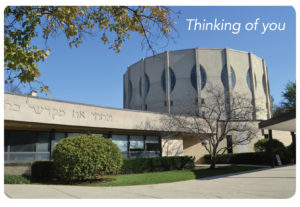 Channon, Barbara Hochwert, Jackie Melinger, Basia Retsky, and Pam Schlosberg. As its name implies, we have a whole group of friendly Beth El members trained in the Mitzvah and ready to assist. While we can always improve, I think Beth El succeeds when it comes to meeting the needs of congregants who are in hospitals.
Yet there are many people who could use a visit and conversation who are out of the hospital. Maybe they’re in a rehab facility like Whitehall. Or maybe they’re at Gidwitz or at home but unable to go out during the day. They should enjoy company as well – if they would like – from the clergy and maybe members of the Bikkur Cholim Caring Community.
But I don’t know who is homebound because they often don’t tell me. So if you know somebody like this who could use some company or a visit, please tell me (with their permission).
Please let me know if you have a family member who might benefit from this Mitzvah. My email is [email protected]. This will be confidential.
Beth El does its best to be a caring community. We feel we’re ready to take the next step, which will really benefit all of us.
Bikkur Cholim is a Mitzvah because when we keep company with someone who is challenged in these ways, we are emulating G-d Who visited the sick, in the case of Abraham (Talmud: Sotah 14a). Through this Mitzvah we make G-d more present in the world.
By Hazzan Barbara Barnett
I am writing my Thursday Thought on Monday, Rosh Chodesh Shevat. As some of you may know, Rosh Chodesh is considered a holiday specifically for women. (The “why” will be the topic for another Thursday thought.) So, why do I mention it now? We are, in the annual Torah reading cycle, in the midst of retelling the story of the Israelite enslavement in Egypt and our eventual exodus, and I’m reminded of the amazing women in the story, and want to share them with you, and their goals and actions that made them both partners with G-d and heroes of our freedom from slavery.
The story begins with the midwives Puah and Shifra. For without them and those like them, the story never happens at all. We don’t know for certain whether the two women were Israelites or Egyptians. We only know they were midwives who refused Pharaoh’s order to kill each male baby born to an Israelite family. We know they assisted with the births of both Egyptian and Hebrew babies, but not whether they, themselves, were Israelites. They, and any others like them, made a dangerous decision to refuse to “follow orders,” doing the right and just thing, rather than the expedient, safe, thing.
The preeminent Torah commentator Rashi 1040-1105 explained that the name Shifra originates in the Hebrew root m’shaperet, “to beautify” or “to swaddle or cleanse, perhaps to “make things better.” Puah’s name may signify a gentle, soothing way of speech. Both were courageous and, perhaps, saved an entire people.
Then Moses is born, and his mother Yocheved, defying Pharoah’s orders to hand him over and be murdered, instead hides him, until she can no longer can. Miriam, then, as you all know, places Moses in a basket and sends him down the River Nile, where he is found by Pharaoh’s daughter, known as Batya. Batya knew that Moses was likely an Israelite baby, yet she took him in and raised him as her own. But her action, quietly defiant, saved Moses for his yet-to-come (co-) starring role in saving the Israelites from slavery. Her name can be translated as “bat yah,” no less than a Daughter of G-d, and in a profound way G-d’s partner in the redemption of the Israelites from their Egyptian slavery.
Last, but certainly not least, is Tziporah, Moses’s wife, who saved Moses from G-d’s wrath while they were encamped on the route to Egypt before the Exodus.
Miriam, Yocheved, Shifra, Puah, Batya, Tziporah: five women who embody the idea of smart, courageous women, who knew their value and acted upon it when called to do so! As we begin this new month of Shevat and continue to read about these brave women, I wish you a (slightly belated) Chodesh Tov.
by Hazzan Ben Tisser
Next Monday we will celebrate Rosh Chodesh Shevat, the beginning of the new month of Shevat. Of course this month is best known for being the host to the Tu B’Shevat holiday, which we celebrate as the “birthday of the trees.” I have many fond memories of being a student in day school in Los Angeles, attending assemblies where we sang Israeli songs about trees and nature, and then went up into the Santa Monica Mountains to plant evergreen trees. We were taught that children in Israel were doing that very same activity that very same day in the hills around Jerusalem.
As a child in LA, it was perhaps more challenging to understand the nature (pun intended) of Tu B’Shevat than it is here in Chicago. Winter brought cool mornings, yet the sun still shined brightly most days, and the majority of trees and flowers remained in bloom throughout the year…so there wasn’t this sense of transition out of winter in the same way. In Israel, it is around this time that the shkediyah, the almond tree, begins to bloom, signifying that although we are still in the throes of winter, spring isn’t far off, and that the promise of nature renewing itself is very real.
Last year, Shevat took on a new meaning for me and my fiancée, Robyn. On 5 Shevat, Robyn lost her teenage son; and on Tu B’shevat, we brought him to his final rest. There are certain details I don’t wish to discuss here. What I do want to share, however, is that there is something painfully beautiful about recalling Isaac’s memory each year at this time.
When we experience a loss of any kind, there is a period of sadness. Obviously it’s on a completely different scale, but even when we get to the end of autumn and the trees are bare, our mood changes. We know that for the next few months we will have lost something significant in the beauty of nature. And then comes the end of winter with the promise of renewal. Life moves forward. Trees grow new leaves; flowers bud and blossom anew…none exactly as the year before, and none with any hint of how things will develop in the year ahead…but there is this sense of renewal nonetheless. And so on Tu B’Shevat we have a seder. We celebrate the promise of nature by tasting sweet fruits and nuts, saying blessings over the beauty and wonder of nature.
In our home, Tu B’Shevat will be different. This year it marks one year since we buried a beautiful young man. It has been a difficult year. And yet, as our family has taken new shape, it has been a very wonderful year. This year we will be sad as we remember Isaac, but we will be filled with hope and wonder at the power of the universe to propel us forward, as we look ahead to days of celebration, of love, and of new stages in life. And that is the very miracle that makes life so wondrous.
I would suggest to us all that this year we make something special of Tu B’Shevat. Let us find that for which to be grateful in our lives. Let us look ahead with hope to the warm, beautiful days of spring. Let us remember that which has transpired since the last New Year of the Trees, and let us be filled with wonder and excitement for that which is yet to come.
By Rabbi Alex Freedman
Be kind to the stranger: they may grow up to change the world, or at least yours.
If courage had a hall of fame, Shifra and Pua would stand at its entrance. These two women star in Parashat Shmot, this week’s Parsha that begins the saga of the Exodus. These two women are largely unknown, which is a shame. For their example continues to lead us.
Shifra and Pua are the Hebrew midwives charged with delivering the Israelite babies. Pharaoh commands them to kill the baby boys but let the girls live. The Torah continues, “The midwives feared G-d and did not do as the King of Egypt instructed. They let the boys live” (Ex. 1:17).
When Pharoah saw Jewish babies being born, he confronted Shifra and Pua. “How could you let them live?” he cried out. They replied, “The Hebrew women are not like the Egyptian women; they are vigorous. Before the midwife can reach them, they’ve given birth.”
Their act of bravery is the first recorded act of civil disobedience, so timely in the days leading up to Martin Luther King Jr. Day.
Are these remarkable women Jewish? I don’t believe so. “Hebrew midwives” can mean midwives for the Hebrews. Why would Pharaoh ever expect a Jewish woman to murder Jewish babies? Instead they are two Egyptian women who fear G-d more than Pharaoh, who refuse to take part in a crime against humanity. Shifra and Pua see the stranger as themselves and are thus worth saving. Who knows who these innocent babies might grow up to be?
We do. Moses was one of them. Moses, whose people would one day create in the state of Israel a Tel Aviv maternity hospital at the intersection of Shifra and Pua Streets.
There’s an inspiring story in my favorite Haggadah, called A Different Night. It goes like this:
“One Sunday morning in 1941 in Nazi-occupied Netherlands, a mysterious character rode up on his bicycle and entered the Calvinist Church. He ascended the podium and read aloud the story of the midwives who saved the Hebrew babies and defied Pharaoh’s policy of genocide. “Who is today’s Pharaoh?” he asked.
“Hitler,” the congregation replied.
“Who are today’s Hebrew babies?”
“The Jews.”
“Who will be today’s midwives?”
He left the church, leaving his question hanging in the air.
During the war seven families from this little church hid Jews and other resisters of the Nazis.”
Shifra and Pua inspired these families to see the stranger as an insider, not an outsider. They changed the world for these families.
This time we read the Exodus story, let us not only condemn Pharaoh but also praise his midwives for their unmatched bravery. The Exodus experience reveals humanity at its lowest point and at its highest.
by Rabbi Michael Schwab
In life, consciously or unconsciously, we often search for how to bring good into the world and positivity into our lives. This can seem to be a challenge because we sometimes perceive that there is so much that is not in our control and that evil forces abound. Yet, we do indeed possess a significant power (amongst others) to bring goodness into our lives and into the lives of others. And what is more, we can use this power as often as we wish — the power of blessing. In this week’s Torah portion when Jacob knows he will die, he calls his family together and blesses his children and grandchildren. When the Jewish people are assembled together in front of the mishkan, their portable sanctuary, God blesses them through the priests. We use these words in the name of Jacob’s blessing to his grandsons on Friday nights to bless our children, at weddings to bless newly married couples and at various other moments to bring hope and positivity into the lives of those present. Yet we need not wait for such special occasions and we need not use only these traditional words. We each have the power to bless others at any moment, sharing our love, positive reflections on the character of others and the hopes and dreams we have for them. Giving blessings is a powerful way to roll back darkness and to create space for the goodness we all want in our lives and in the world. May we all realize the potential for blessing in each other and in ourselves as well. Amen!
By Hazzan Ben Tisser
These last weeks have been difficult for our country, particularly for the Jewish community. From a ransacked synagogue in Beverly Hills (where, incidentally, I have taught and sung) to a kosher market shooting in New Jersey to a stabbing in a Rabbi’s home in Monsey, this has been a painful time for us. I will share that my morning ritual is to have a cup of Elite instant coffee while watching the last 15 minutes of the 6 AM news before heading to Minyan, and that for the past while I have actually debated in my head whether or not I wish to turn on the TV for fear of more devastating news.
I am not going to use this space to speak against these most recent anti-Semitic acts. The media, our institutions and other organizations are doing plenty of that. I am not going to speak of politics, for that is not my place. What I will write about are two words that, at their core, are very Jewish: faith and hope.
Our entire history as a people has been based on faith and hope. Without faith and hope, we would never have endured centuries of slavery in Egypt, all the while retaining our identity while living and slaving in a land not our own. Without faith and hope we would not have survived the destruction of our Temples or the expulsion from Spain. Without faith and hope, those brave souls who survived the Shoah and those who did not would not have tried with their whole beings to make it through. And without faith and hope we would not have a Jewish homeland in the State of Israel today.
At first glance these words are very similar, but there is an important distinction between them. Faith is the firm belief in what is, and hope is the desire for and commitment to ensuring a better future. Faith grounds us and hope drives us. Faith is what allows us to go to sleep at night peacefully, and hope is what encourages us to set our alarms and make plans for tomorrow.
This week we end a decade. I see lots of Facebook posts and receive greetings from friends of “Happy Secular New Year.” I must tell you that I am bothered by the addition of the word “secular” to the greeting. My grandparents and my father came to this country with hope for a better life for our family—a life in which we could retain our rich and special Jewish identities and at the same time be part of the fabric that is America. When we add “secular” to the greeting, we create a separation between “us” and “them,” and I think that particularly given recent events, we would do well to reconsider that. When we separate ourselves out, even internally, we give permission for “them” to do the same. By virtue of living in this country at this time, we share in the joy of a new year. It is a time for families and friends to be together, for us to watch whomever the new host of the Dick Clark’s Rockin’ New Year’s Eve is, and to count backwards from ten as we watch an enormous crystal ball descend where a large Minolta sign was once hung on a New York City skyscraper as millions of people crowd the street below. Yes, it is a time for celebration. It is a time to dream and to resolve. And, it is a time for hope.
I hope that next year will be better—for us, and for the world. And what drives my hope is faith. I have faith in our values, I have faith in our ability to catalyze change, and I have faith in each one of us as a leader in our own circles. If we each take charge of a small, broken corner of the world, as a community we may be able to repair one pane in the large window of the universe…and that will make a difference.
We pray that the memories of those lost to acts of senseless violence and hatred be a blessing, and serve as an inspiration for us to continue the sacred work of tikkun olam, repairing or improving the world. We pray for their families. We pray that those injured will heal, in body and in spirit. We pray that communities directly affected will again find a sense of calm and security.
May the third decade of the 21st century be one of greater peace and stability, of understanding and appreciation of the other. May we know good health, deep love, and only good things. I look forward to seeing you in shul and being able to personally wish each of you a Happy New Year.
By Hazzan Barbara Barnett
We are in the midst of Hanukkah, the Festival of Light. Exactly why we celebrate it has been a matter of debate for generations. Yes, we celebrate a miracle, for as it is written upon the letters of the dreidel (Nun, Gimel, Hey, Shin—or if you are in Israel, Peh) in acronym: “a great miracle happened there” (or in Israel, “here.”)
But which miracle are we celebrating? The miracle of a small band of zealous Jews who refused to give into the oppressive demands of the Syrian-Greeks, led by the tyrant Antiochous? Or the later traditional explanation: that a small cruse of pure oil, needed to relight the menorah in the Temple lasted for eight days? Or is the real miracle that the people, despite knowing the oil would last only one day, lit it anyway, and in so doing demonstrated that while much had been destroyed, their hope and courage could not be quashed? In the end, does it matter?
Perhaps, the miracle of the tiny vessel that prevailed against all odds to last far longer than anyone might have anticipated is a metaphor for the rebellion. The defeat of the mighty by the small and inspired—it is a proud tradition for us to remember. A miracle in the midst of certain defeat—the spirit of the few prevailing over the physical might of the powerful.
We recall the miracle in ritual, song, and even (of course) in our gastronomic choices. We light the chanukiah, beginning with a single candle for the first night, and each night increasing the light by one candle, until all eight (plus the shamash) are ablaze. The second blessing we recite: “she-asah nisim l’avoteinu, ba-yamim ha-heim, baz’man hazeh” thanks God for the “miracles that God made for our ancestors in their days at this season.” We eat latkes and jelly donuts (sufganiot) fried in olive oil to recall the miracle (metaphorical or not) of the oil.
Hanukkah, which, in Hebrew, means “dedication,” is also the Festival of Light, and many other religious traditions celebrate winter festivals of light, at this, the darkest time of the calendar year. But I think, the connection between Hanukkah, the light of the candles, the spirit of a small band of people (the Maccabbees) to defeat a much bigger foe, the miracle of a small vessel of oil lasting a week has another dimension.
The Baal Shem Tov, 18th Century founder of Chassidism, said, “From every human being there rises a light that reaches straight to heaven.” Each of us has within us the light, the spark of the Divine, to prevail against the odds and do amazing things.
The prophet Zechariah says in the haftarah for Shabbat Hanukkah, “Not by might, and not by power, but by my spirit…” Perhaps we are meant, at this time of the year (“ba’zeman hazeh”) to rededicate ourselves in the darkest, coldest time of the year to renewing that spark of light that resides in all of us.
Each of us has that light, no matter how dimmed it might have grown over a difficult year or other adversity, or how brightly it still shines in your life. In this joyous season of Hanukkah, surrounded by the light of the chanukia, by celebration, by song, and community can be rededicated, relit, renewed for another year.
by Rabbi Michael Schwab
Watching this video made me so proud to be a rabbi at NSS Beth El. It brings to life our commitment to disability inclusion, which I see as fundamental to being a synagogue.
Every person wants to feel a sense of connection. And every Jew should be able to feel that they have a synagogue that feels like home. We are a Beit Knesset (Hebrew for synagogue) and therefore we are literally a “house for all people to enter.” We are an address for any Jew in our community to engage in our beautiful heritage, to connect with God and to draw close to fellow Jews.
Therefore it is our sacred task to make sure our synagogue community is accessible and inclusive. And inclusion isn’t simply a program or an initiative, but a deep, abiding framework and viewpoint through which we see the world. Just as we all stand together before God with all of our quirks, faults, strengths and blessings, hoping and knowing that God sees the infinite value in each of us, so too we should be able to all stand before each other with our abilities and disabilities and know that the other sees in us that same infinite value. We should feel secure in the fact that our synagogue affords us the opportunity to share in the blessings of our wonderful community.
I am so proud that our congregation has taken this value so seriously. I invite you to view this new video of the Ruderman Family Foundation and USCJ which features NSS Beth El. It was featured at the recent United Synagogue convention. If you would like to become more involved with disability inclusion, please contact me at [email protected]. Shabbat Shalom and Happy Hanukkah in advance!
1175 Sheridan Road, Highland Park, IL 60035 | (847) 432-8900 | [email protected] |


Copyright © 2026. All rights reserved. Website designed by Addicott Web.